From Vision to Reality
From Vision to Reality
From Vision to Reality

Client
Client
Client
Team
Team
Team
Course
Course
Course
Timeframe
Timeframe
Timeframe
Shiv, founder of Protect Art
Shiv, founder of Protect Art
Mursal Ashrafi, Morgan Bath, Helya Modarressi Tehrani, Allison Ren, Pan Xie
Mursal Ashrafi, Morgan Bath, Helya Modarressi Tehrani, Allison Ren, Pan Xie
Business Design (SFIN-6012) & Leading Innovation (6014), Spring/Summer 2024
Business Design (SFIN-6012) & Leading Innovation (6014), Spring/Summer 2024
six weeks, 2024
six weeks, 2024
six weeks, 2024
My Role
My Role
Contributed across research and strategy, and led design of the 122-page final report and presentation.
Contributed across research and strategy, and led design of the 122-page final report and presentation.
Contributed across research and strategy, and led design of the 122-page final report and presentation.

The Problem
The Problem
Our client came to Protect Art from photography. Editing his own images, he found the process inefficient enough to build an AI tool that automated the tedious parts. That worked, and it led somewhere more ambitious: personal AI models trained on an individual artist's style, so the artist could generate new work in their own hand, set their own pricing, and keep control of the rights.
The intent was to give artists more power. The artistic community heard something else entirely.
Their feedback surfaced deep concern about what generative AI meant for their work, their livelihoods, and their consent — ethical and emotional territory rather than a feature gap. It was the kind of response that tells you the problem you thought you were solving is not the problem people have.
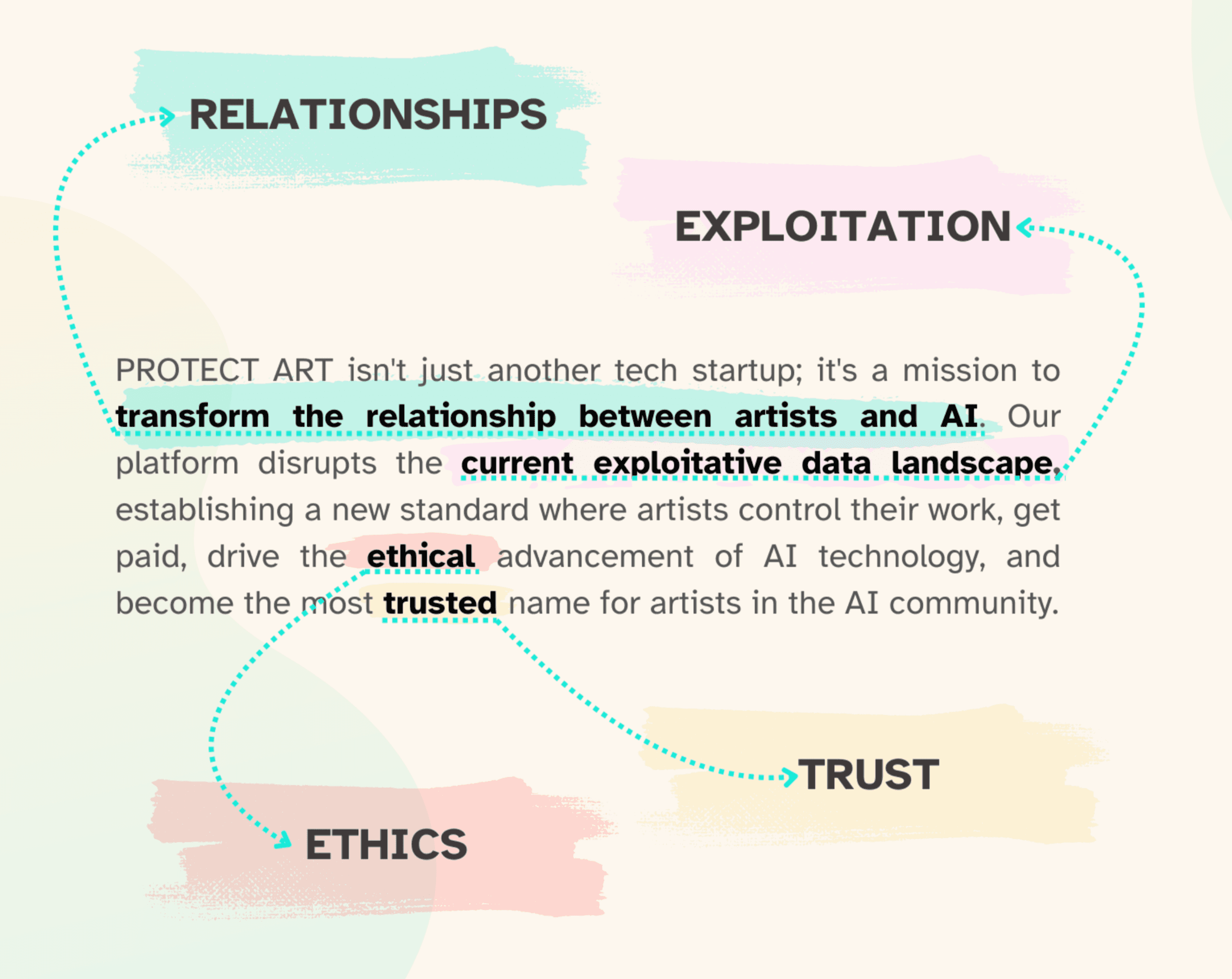
Protect Art was his answer: a mission-driven platform to change the relationship between creatives and AI companies rather than to sell another tool. The conviction was real. The specifics were not yet there. He asked us what it would take to turn it into a viable business.
Our client came to Protect Art from photography. Editing his own images, he found the process inefficient enough to build an AI tool that automated the tedious parts. That worked, and it led somewhere more ambitious: personal AI models trained on an individual artist's style, so the artist could generate new work in their own hand, set their own pricing, and keep control of the rights.
The intent was to give artists more power. The artistic community heard something else entirely.
Their feedback surfaced deep concern about what generative AI meant for their work, their livelihoods, and their consent — ethical and emotional territory rather than a feature gap. It was the kind of response that tells you the problem you thought you were solving is not the problem people have.
Protect Art was his answer: a mission-driven platform to change the relationship between creatives and AI companies rather than to sell another tool. The conviction was real. The specifics were not yet there. He asked us what it would take to turn it into a viable business.
Our client came to Protect Art from photography. Editing his own images, he found the process inefficient enough to build an AI tool that automated the tedious parts. That worked, and it led somewhere more ambitious: personal AI models trained on an individual artist's style, so the artist could generate new work in their own hand, set their own pricing, and keep control of the rights.
The intent was to give artists more power. The artistic community heard something else entirely.
Their feedback surfaced deep concern about what generative AI meant for their work, their livelihoods, and their consent — ethical and emotional territory rather than a feature gap. It was the kind of response that tells you the problem you thought you were solving is not the problem people have.
Protect Art was his answer: a mission-driven platform to change the relationship between creatives and AI companies rather than to sell another tool. The conviction was real. The specifics were not yet there. He asked us what it would take to turn it into a viable business.
The Process
The Process
We worked through the Double Diamond — Discover, Define, Develop, Deliver — and let each phase narrow the last.
Discover. Primary research through surveys and interviews, including in-depth conversations with artists in Toronto, alongside desk research and an environmental scan covering copyright law, the state of generative AI, and the AI companies themselves. What emerged was a mismatch: creatives and AI companies were not simply in conflict, they wanted structurally different things, on different timelines, for different reasons.
Define. Cross-analysis of the survey data produced something more useful than a general finding about mistrust. Creatives were not one audience.
Develop. Ideation and prioritization around a single question: what would actually bring the two most polarized groups into the same room?
Deliver. Business Model Canvas, wireframe prototyping, and a follow-up survey to pressure-test desirability, feasibility, and viability, then a phased strategy and implementation roadmap.
We worked through the Double Diamond — Discover, Define, Develop, Deliver — and let each phase narrow the last.
Discover. Primary research through surveys and interviews, including in-depth conversations with artists in Toronto, alongside desk research and an environmental scan covering copyright law, the state of generative AI, and the AI companies themselves. What emerged was a mismatch: creatives and AI companies were not simply in conflict, they wanted structurally different things, on different timelines, for different reasons.
Define. Cross-analysis of the survey data produced something more useful than a general finding about mistrust. Creatives were not one audience.
Develop. Ideation and prioritization around a single question: what would actually bring the two most polarized groups into the same room?
Deliver. Business Model Canvas, wireframe prototyping, and a follow-up survey to pressure-test desirability, feasibility, and viability, then a phased strategy and implementation roadmap.
We worked through the Double Diamond — Discover, Define, Develop, Deliver — and let each phase narrow the last.
Discover. Primary research through surveys and interviews, including in-depth conversations with artists in Toronto, alongside desk research and an environmental scan covering copyright law, the state of generative AI, and the AI companies themselves. What emerged was a mismatch: creatives and AI companies were not simply in conflict, they wanted structurally different things, on different timelines, for different reasons.
Define. Cross-analysis of the survey data produced something more useful than a general finding about mistrust. Creatives were not one audience.
Develop. Ideation and prioritization around a single question: what would actually bring the two most polarized groups into the same room?
Deliver. Business Model Canvas, wireframe prototyping, and a follow-up survey to pressure-test desirability, feasibility, and viability, then a phased strategy and implementation roadmap.

What we Found: four archetypes
What we Found: four archetypes
Segmenting on two axes, whether a creative uses generative AI tools and how strongly they react to them, produced four distinct groups.
Creative Ideologues do not use AI tools and react strongly against them. They fear that AI is becoming just good enough to flood the field with mediocre work, that quality will fall, and that AI companies are training on stolen material. They want to understand copyright and the technology well enough to defend their rights. They were 41% of respondents, the largest group by a wide margin.
Early Adopters use AI tools and react strongly in favour. They see creativity as continually evolving and AI as the next place to push. They know the tools, use them in practice, and want better ones alongside legal clarity so they can experiment without exposure. They were 21%.
Lurkers (14%) do not use the tools and feel indifferent. Trend Followers (19%) use them and feel indifferent.
We focused on the two strong-reaction groups. Not because they were the largest, but because polarized positions surface the sharpest tensions, and sharp tensions produce better solutions than lukewarm ones.
The strategic insight followed from that. If Protect Art was going to live out its mission, it could not start by mediating between creatives and AI companies. It had to start with the creatives themselves — building trust, community, and education first, so that people entered any future conversation with power rather than fear.
Segmenting on two axes, whether a creative uses generative AI tools and how strongly they react to them, produced four distinct groups.
Creative Ideologues do not use AI tools and react strongly against them. They fear that AI is becoming just good enough to flood the field with mediocre work, that quality will fall, and that AI companies are training on stolen material. They want to understand copyright and the technology well enough to defend their rights. They were 41% of respondents, the largest group by a wide margin.
Early Adopters use AI tools and react strongly in favour. They see creativity as continually evolving and AI as the next place to push. They know the tools, use them in practice, and want better ones alongside legal clarity so they can experiment without exposure. They were 21%.
Lurkers (14%) do not use the tools and feel indifferent. Trend Followers (19%) use them and feel indifferent.
We focused on the two strong-reaction groups. Not because they were the largest, but because polarized positions surface the sharpest tensions, and sharp tensions produce better solutions than lukewarm ones.
The strategic insight followed from that. If Protect Art was going to live out its mission, it could not start by mediating between creatives and AI companies. It had to start with the creatives themselves — building trust, community, and education first, so that people entered any future conversation with power rather than fear.
Segmenting on two axes, whether a creative uses generative AI tools and how strongly they react to them, produced four distinct groups.
Creative Ideologues do not use AI tools and react strongly against them. They fear that AI is becoming just good enough to flood the field with mediocre work, that quality will fall, and that AI companies are training on stolen material. They want to understand copyright and the technology well enough to defend their rights. They were 41% of respondents, the largest group by a wide margin.
Early Adopters use AI tools and react strongly in favour. They see creativity as continually evolving and AI as the next place to push. They know the tools, use them in practice, and want better ones alongside legal clarity so they can experiment without exposure. They were 21%.
Lurkers (14%) do not use the tools and feel indifferent. Trend Followers (19%) use them and feel indifferent.
We focused on the two strong-reaction groups. Not because they were the largest, but because polarized positions surface the sharpest tensions, and sharp tensions produce better solutions than lukewarm ones.
The strategic insight followed from that. If Protect Art was going to live out its mission, it could not start by mediating between creatives and AI companies. It had to start with the creatives themselves — building trust, community, and education first, so that people entered any future conversation with power rather than fear.

The Strategy
The Strategy
We proposed a freemium model in three phases, each building on the last.
Phase 1 — Education Platform. Foundation period. Three pillars. Education: courses on intellectual property, contract agreements, and how AI actually works, from beginner through certification. Community: an open forum, online and in-person events, resource pools, and member-led courses. Legal support: free legal resources and low-cost connections to a network of trusted lawyers.
Phase 2 — Copyright Detector. Expansion period. A new revenue stream, tested for viability against the foundation Phase 1 establishes.
Phase 3 — Database. Maturity period. Infrastructure to sustain the platform and support continued growth.
Underneath all three, the innovation intent we articulated with him: Protect Art will empower creatives to reclaim their agency through accessible education on AI, copyright law, and legal rights, a community of like-minded people, and the ability to make informed decisions without fear or ignorance.
Phase 1 came with a four-stage implementation roadmap — Development, Beta Launch, Launch, Growth — each stage carrying its own activities and the milestones that signal readiness to move to the next. Secure funding, develop partnerships, build content, build the platform. Then host beta users, assess product-market fit, iterate, ensure compliance. Then launch marketing, build community, refine engagement, plan for growth.
We proposed a freemium model in three phases, each building on the last.
Phase 1 — Education Platform. Foundation period. Three pillars. Education: courses on intellectual property, contract agreements, and how AI actually works, from beginner through certification. Community: an open forum, online and in-person events, resource pools, and member-led courses. Legal support: free legal resources and low-cost connections to a network of trusted lawyers.
Phase 2 — Copyright Detector. Expansion period. A new revenue stream, tested for viability against the foundation Phase 1 establishes.
Phase 3 — Database. Maturity period. Infrastructure to sustain the platform and support continued growth.
Underneath all three, the innovation intent we articulated with him: Protect Art will empower creatives to reclaim their agency through accessible education on AI, copyright law, and legal rights, a community of like-minded people, and the ability to make informed decisions without fear or ignorance.
Phase 1 came with a four-stage implementation roadmap — Development, Beta Launch, Launch, Growth — each stage carrying its own activities and the milestones that signal readiness to move to the next. Secure funding, develop partnerships, build content, build the platform. Then host beta users, assess product-market fit, iterate, ensure compliance. Then launch marketing, build community, refine engagement, plan for growth.
We proposed a freemium model in three phases, each building on the last.
Phase 1 — Education Platform. Foundation period. Three pillars. Education: courses on intellectual property, contract agreements, and how AI actually works, from beginner through certification. Community: an open forum, online and in-person events, resource pools, and member-led courses. Legal support: free legal resources and low-cost connections to a network of trusted lawyers.
Phase 2 — Copyright Detector. Expansion period. A new revenue stream, tested for viability against the foundation Phase 1 establishes.
Phase 3 — Database. Maturity period. Infrastructure to sustain the platform and support continued growth.
Underneath all three, the innovation intent we articulated with him: Protect Art will empower creatives to reclaim their agency through accessible education on AI, copyright law, and legal rights, a community of like-minded people, and the ability to make informed decisions without fear or ignorance.
Phase 1 came with a four-stage implementation roadmap — Development, Beta Launch, Launch, Growth — each stage carrying its own activities and the milestones that signal readiness to move to the next. Secure funding, develop partnerships, build content, build the platform. Then host beta users, assess product-market fit, iterate, ensure compliance. Then launch marketing, build community, refine engagement, plan for growth.

The Design Challenge
The Design Challenge
Five authors, six weeks, 122 pages, and one reader: a founder who needed something he could act on, not a nice report.
Structure first. I built the document in distinct parts — introduction, then a section for each phase of the Double Diamond (Discovery, Definition, Development, Delivery), then conclusion and appendices. Our recommendations were broken into implementation phases, so the strategy arrived as a sequence rather than a wish list.
Colour as navigation. Each phase of the process got its own place in the palette, so a reader always knew where they were in the arc. Built from primary and tertiary colours with gradients, and paired with organic shapes to speak to the creative community at the centre of the business. Underneath, background elements borrowed from cyber and mechanical forms to carry the AI half of the story. The tension in the document's visual language is the same tension the business exists to resolve.
Typography. Set in Atkinson Hyperlegible, designed by the Braille Institute for low-vision readability. Full accessibility compliance was out of scope in six weeks, so the typeface was the baseline commitment I wanted the document to make regardless.
Tooling under constraint. I would have preferred to build this in Adobe. We used Canva because five people needed to write, comment, and revise inside the same file on a six-week clock, and the tool everyone can already use beats the tool one person can use well. Choosing the collaboration over the craft ceiling was the right call for this project.
One document, two audiences. This was a hybrid deliverable, written for the client and submitted for assessment, which meant carrying more explanation than a purely client-facing report would need. Keeping that additional material from swamping the founder's path through the document was a large part of the design problem.
Five authors, six weeks, 122 pages, and one reader: a founder who needed something he could act on, not a nice report.
Structure first. I built the document in distinct parts — introduction, then a section for each phase of the Double Diamond (Discovery, Definition, Development, Delivery), then conclusion and appendices. Our recommendations were broken into implementation phases, so the strategy arrived as a sequence rather than a wish list.
Colour as navigation. Each phase of the process got its own place in the palette, so a reader always knew where they were in the arc. Built from primary and tertiary colours with gradients, and paired with organic shapes to speak to the creative community at the centre of the business. Underneath, background elements borrowed from cyber and mechanical forms to carry the AI half of the story. The tension in the document's visual language is the same tension the business exists to resolve.
Typography. Set in Atkinson Hyperlegible, designed by the Braille Institute for low-vision readability. Full accessibility compliance was out of scope in six weeks, so the typeface was the baseline commitment I wanted the document to make regardless.
Tooling under constraint. I would have preferred to build this in Adobe. We used Canva because five people needed to write, comment, and revise inside the same file on a six-week clock, and the tool everyone can already use beats the tool one person can use well. Choosing the collaboration over the craft ceiling was the right call for this project.
One document, two audiences. This was a hybrid deliverable, written for the client and submitted for assessment, which meant carrying more explanation than a purely client-facing report would need. Keeping that additional material from swamping the founder's path through the document was a large part of the design problem.
Five authors, six weeks, 122 pages, and one reader: a founder who needed something he could act on, not a nice report.
Structure first. I built the document in distinct parts — introduction, then a section for each phase of the Double Diamond (Discovery, Definition, Development, Delivery), then conclusion and appendices. Our recommendations were broken into implementation phases, so the strategy arrived as a sequence rather than a wish list.
Colour as navigation. Each phase of the process got its own place in the palette, so a reader always knew where they were in the arc. Built from primary and tertiary colours with gradients, and paired with organic shapes to speak to the creative community at the centre of the business. Underneath, background elements borrowed from cyber and mechanical forms to carry the AI half of the story. The tension in the document's visual language is the same tension the business exists to resolve.
Typography. Set in Atkinson Hyperlegible, designed by the Braille Institute for low-vision readability. Full accessibility compliance was out of scope in six weeks, so the typeface was the baseline commitment I wanted the document to make regardless.
Tooling under constraint. I would have preferred to build this in Adobe. We used Canva because five people needed to write, comment, and revise inside the same file on a six-week clock, and the tool everyone can already use beats the tool one person can use well. Choosing the collaboration over the craft ceiling was the right call for this project.
One document, two audiences. This was a hybrid deliverable, written for the client and submitted for assessment, which meant carrying more explanation than a purely client-facing report would need. Keeping that additional material from swamping the founder's path through the document was a large part of the design problem.
What I Learned
What I Learned
Six weeks, five contributors, and a vision that kept moving. The scope shifted more than once as the founder's thinking evolved, which meant the research had to stay useful while the target changed. Working on a deliverable whose destination keeps moving taught me to build in a way that holds up under revision: modular sections, a structure that could absorb a new direction without a rebuild, and a design system consistent enough that changed content didn't mean redesigned pages.
Six weeks, five contributors, and a vision that kept moving. The scope shifted more than once as the founder's thinking evolved, which meant the research had to stay useful while the target changed. Working on a deliverable whose destination keeps moving taught me to build in a way that holds up under revision: modular sections, a structure that could absorb a new direction without a rebuild, and a design system consistent enough that changed content didn't mean redesigned pages.
Six weeks, five contributors, and a vision that kept moving. The scope shifted more than once as the founder's thinking evolved, which meant the research had to stay useful while the target changed. Working on a deliverable whose destination keeps moving taught me to build in a way that holds up under revision: modular sections, a structure that could absorb a new direction without a rebuild, and a design system consistent enough that changed content didn't mean redesigned pages.
Read the report
Read the report
The full report was prepared for a client, and parts of it — financial modelling, partnership recommendations, and detailed business planning — belong to him rather than to me. The version below is redacted accordingly.
What remains is the work I can speak to: the research and how it was run, the archetype analysis, the strategic reasoning, and the design system built to carry 122 pages for a single reader.
The full report was prepared for a client, and parts of it — financial modelling, partnership recommendations, and detailed business planning — belong to him rather than to me. The version below is redacted accordingly.
What remains is the work I can speak to: the research and how it was run, the archetype analysis, the strategic reasoning, and the design system built to carry 122 pages for a single reader.
The full report was prepared for a client, and parts of it — financial modelling, partnership recommendations, and detailed business planning — belong to him rather than to me. The version below is redacted accordingly.
What remains is the work I can speak to: the research and how it was run, the archetype analysis, the strategic reasoning, and the design system built to carry 122 pages for a single reader.